


Route 66 Oklahoma-Texas-New Mexico Itinerary

Route 66 Great Plains Road Trip
Start / End
Albuquerque, New Mexico / Tulsa, Oklahoma
States Covered

NM

TX

OK
Suggested Days
9+ Days
Total Distance
650 miles (1,046 kilometers)
Suggested Seasons
All Seasons
#ThisIsMyRoute
Overview
This road trip follows New Mexico Route 66 on the original 1926 alignment from Albuquerque through Santa Fe, New Mexico. Onward, it sweeps across the Texas Panhandle along Texas Route 66 then cruises Route 66 Oklahoma ending in Tulsa, Oklahoma. It’s a journey of jaw-dropping contrasts: turquoise skies over ancient pueblo ruins, neon-splashed motels glowing in the high desert night, ten Cadillacs buried nose-first in a field, and genuine ghost towns that are vivid illustrations of what happened when the Interstate bypassed Route 66 overnight.
Route 66: the Southern Great Plains
Fly into Albuquerque International Sunport and out of Tulsa International Airport. Spend a night in each city before you start and after you finish, both have more than enough to fill an extra day if you let them.
The points of interest listed here are suggestions. Choose all or some, linger where the spirit moves you, and pick an interim overnight stop whenever a day feels too full. Route 66 rewards the unhurried.
More Route 66 Road Trip Tips
Pack layers. Temperatures shift dramatically between New Mexico’s 7,500-foot mountain passes and the open plains of the Texas Panhandle. Comfortable walking shoes are essential, as is sunscreen and a reusable water bottle (the desert is drier than you think). Book your Wigwam-style or vintage motor court accommodations well in advance, especially in peak season; the best spots on the Mother Road fill up fast. If you visit Palo Duro Canyon in summer, reserve cabins the moment the booking window opens as they’re the first to go.
Cell service can be spotty through New Mexico and the Texas Panhandle, so download offline maps and consider picking up a physical Route 66 guidebook. Most importantly leave room in the schedule. You will stop more than you planned, and every single stop will be worth it.
Be sure to check hours of operation for all destinations you plan to visit to avoid disappointment.
DAY 1: ALBUQUERQUE, NM
Albuquerque, NM
The Longest Urban Route 66 Section
The longest urban stretch of Historic Route 66 in the US runs right through Albuquerque’s heart. But save this opening drive for late evening when the neon signs light up and the colors pop against a darkening sky.
Start your day with a ride on the Sandia Peak Tramway, the longest aerial tramway in the Americas. Climbing 2.7 miles up the granite face of the Sandia Mountains, the tram car rises to 10,378 feet / 3,163 meters from high desert to alpine forest in under 15 minutes. The views over Albuquerque, the Rio Grande Valley, and, on clear days, as far as 11,000 square miles of New Mexico and beyond are a jaw-dropping introduction to New Mexico’s scale. Book the first morning tram to beat the crowds.
Step off the tram and back into ancient history at Petroglyph National Monument where thousands of rock carvings trace the spiritual world of the ancestral Puebloans. The Indian Pueblo Cultural Center is the gateway to New Mexico’s 19 Pueblos showcasing culture, lifestyle, art, traditional dances, and food from ancient times to the present. The café serves authentic New Mexican cuisine. This is essential cultural context for the journey ahead.
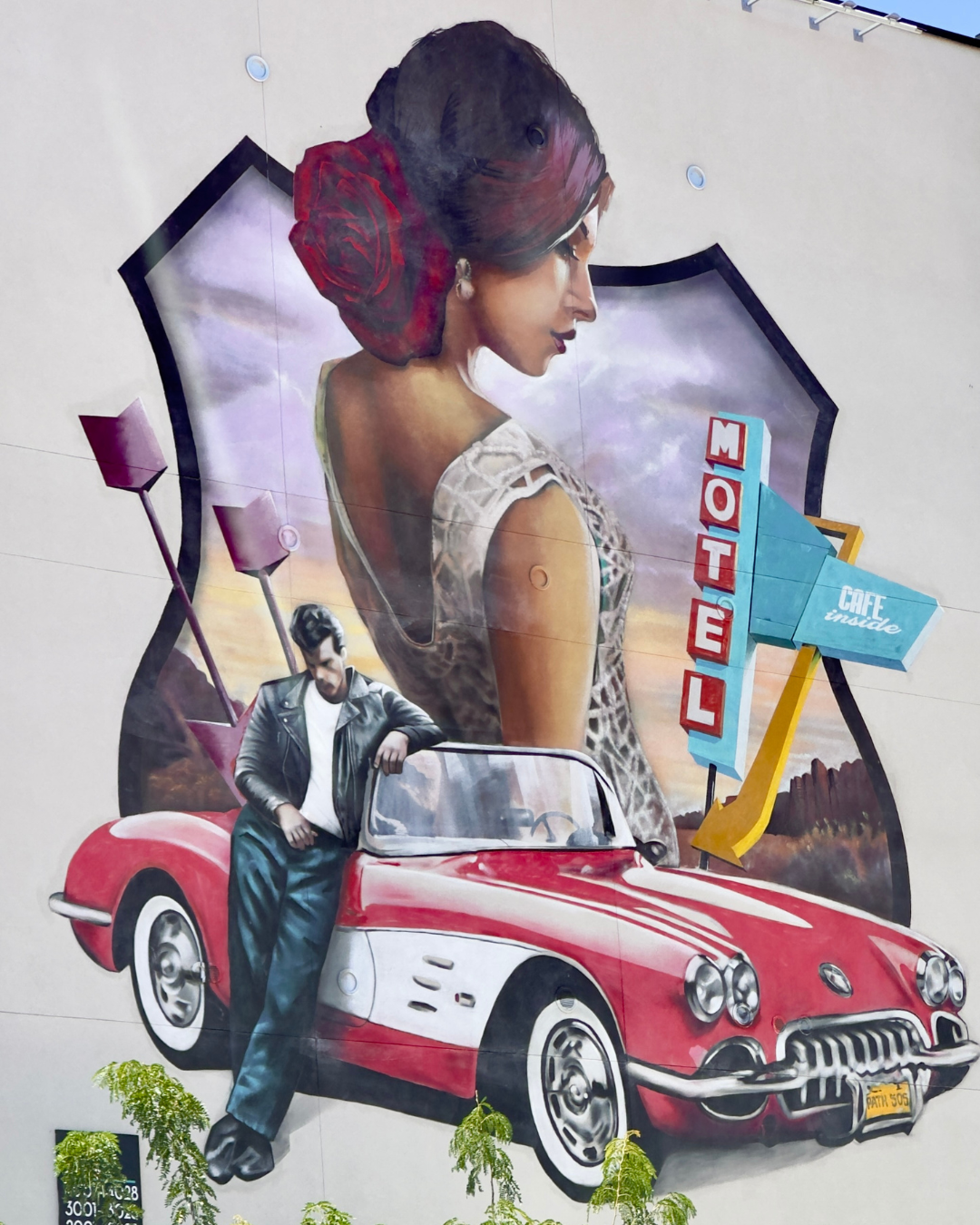
At the end of the day take a slow cruise along Historic New Mexico Route 66 / Central Avenue to reveal a living museum of mid-century Americana. The vintage neon signage, historic buildings, and decades of character have beckoned weary travelers for 100 years. More than mere roadside beacons, Route 66’s neon signs were luminous promises of rest, of warmth, of human connection while breathing economic pride and modern ambition into the small towns they called home. Today many still flicker with a nostalgia inseparable from the road’s own restless soul.
Look for the KiMo Theatre, a 1927 Pueblo Deco movie palace with one of the most photographed neon marquees on the entire Mother Road. Enjoy dinner at the legendary 66 Diner, a 1940s Phillips 66 station reborn as a Streamline Moderne diner with soda fountains and Route 66 memorabilia. Then stroll Nob Hill, New Mexico’s first drive-in shopping center (1947), now a walkable strip of indie boutiques and breweries.
Also look out for these other famous signs: The Dog House Drive-in, De Anza Motor Lodge, and Loyola’s Family Restaurant.
Where to Stay:
El Vado Motel (1937 Pueblo Revival motor lodge)
Hotel Andaluz (boutique art deco)
Where to Eat:
Casa de Benavidez (authentic green chile)
Frontier Restaurant (Legendary University of New Mexico institution)
Other things to see/do:
Balloon Feista, a seasonal 9-day event spanning the first full week of October is the world’s largest hot air balloon festival.
DAY 2: TURQUOISE TRAIL TO SANTA FE
Albuquerque to Santa Fe
The Original 1926 Route 66
The original Route 66 from Albuquerque to Santa Fe has been paved over by I-25, so swap the interstate for the Turquoise Trail. This scenic state road NM-14 cuts through the Sandia foothills and weaves through high desert and canyons of central New Mexico.
Your first stop is Madrid, a former coal-mining ghost town that spectacularly reinvented itself as one of New Mexico’s most vibrant arts communities. Main street is a lively collection of studios, galleries, and the irresistible Mine Shaft Tavern. A few miles north is Los Cerrillos, a near-ghost town with a 2,000-year history of turquoise and gold mining; it’s quiet in a way that feels borrowed from another century.
As you continue on toward Santa Fe stop at either (or both) the Museum of Encaustic Arts, dedicated to the ancient technique using molten beeswax mixed with pigment, revived here as a contemporary fine art medium, or the Box Studio Origami Sculpture Garden.
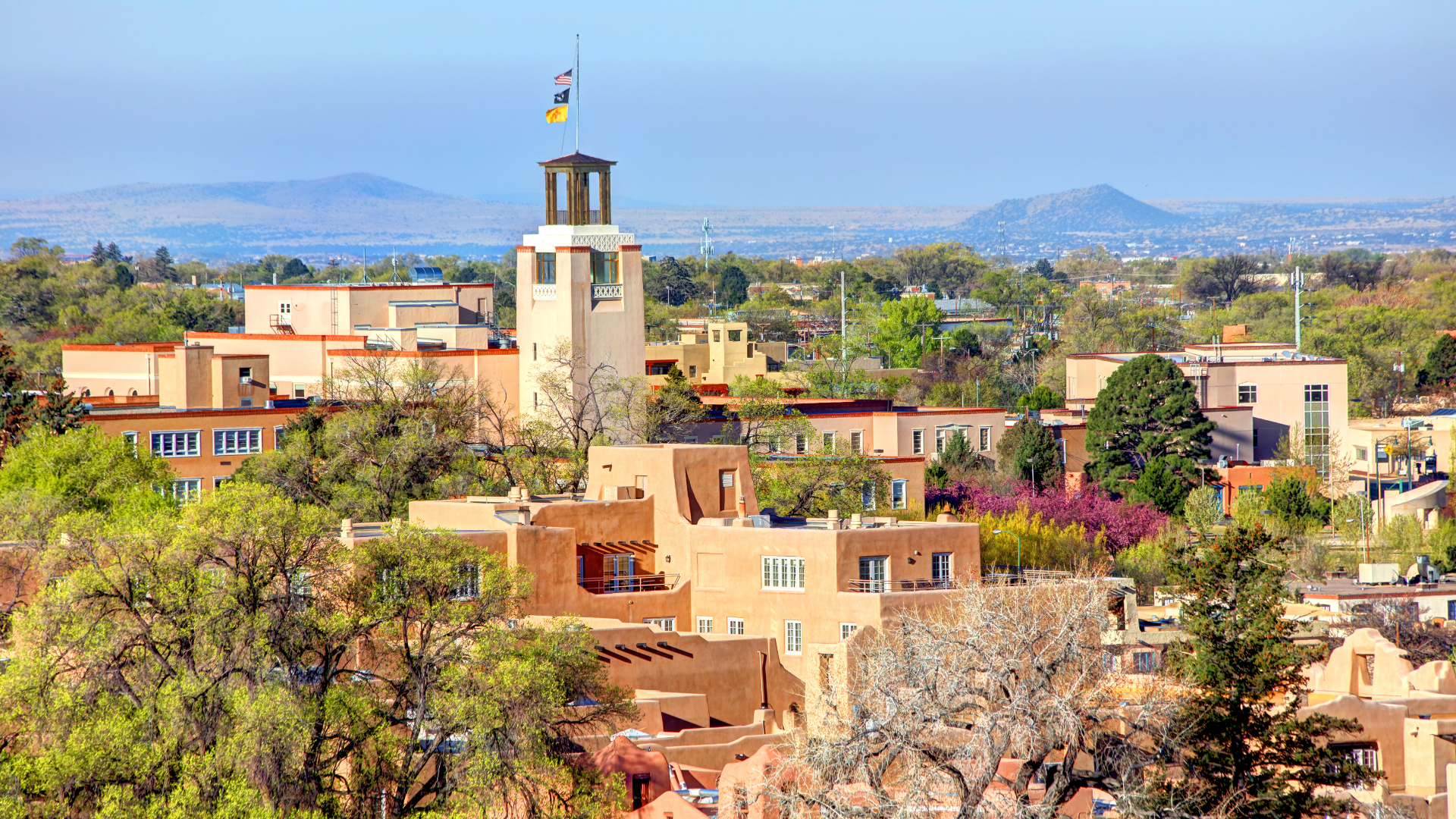
By late afternoon, arrive in Santa Fe, the nation’s oldest state capital and the northern terminus of the original 1926 Route 66 alignment. Settle in and absorb the adobe glow in the golden hour.
Where to Stay:
La Fonda on the Plaza (1922 Harvey House, Historic Hotels of America)
El Rey Court (restored 1930s motor court)
Where to Eat:
The Shed (Santa Fe institution since 1953)
Cafe Pasqual’s (upscale Mexican)
La Plazuela at La Fonda (inside the hotel’s stunning painted courtyard)
DAY 3: SANTA FE, NM
Santa Fe
The City Different
One full day is barely enough for Santa Fe. It is extraordinary, ancient, and fiercely itself. Begin at the Georgia O’Keeffe Museum, where ten beautiful adobe galleries hold the world’s largest collection of her work. It’s easy to spend two hours without noticing.
The Santa Fe Plaza has been the city’s beating heart since 1610, serving as the end of the Santa Fe Trail and the northern anchor of the original Route 66.
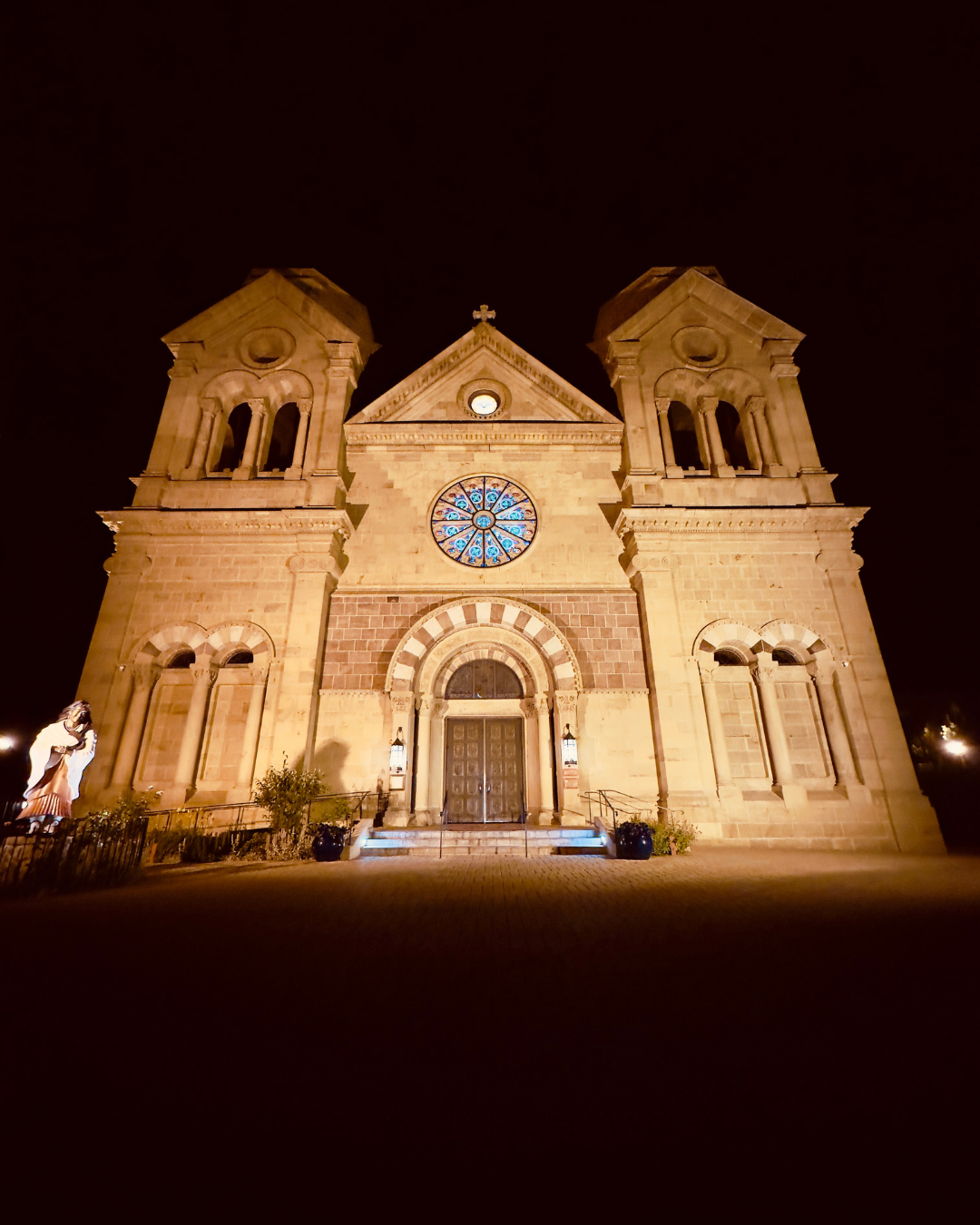
Linger at the Palace of the Governors, the oldest continuously occupied public building in the United States, where Native American artists sell jewelry under the portals as they have for centuries. Look up at the soaring Cathedral Basilica of St. Francis of Assisi, which rises unexpectedly from the surrounding adobe like a French Romanesque dream.
San Miguel Chapel, built around 1610 and considered the oldest church in the continental United States, stands directly on the original New Mexico Route 66 alignment along Old Santa Fe Trail — a humbling, quiet stop.
For something uniquely memorable, board the Sky Railway for a scenic run between Santa Fe and Lamy, complete with live entertainment, great food, and drinks on board.
Where to Stay:
Inn and Spa at Loretto (Pueblo Revival adobe on the original Route 66 alignment)
Santa Fe Motel (Locally owned)
Where to Eat:
Horno Restaurant (farm to table)
Sazón Restaurant (elevated Latin American cuisine)
Other things to see/do:
New Mexico Museum of Art
Museum of Indian Arts & Culture
Santa Fe Botanical Garden
DAY 4: SANTA FE TO TUCUMCARI
Glorieta Pass, Pecos & Santa Rosa
Blue Hole & Neon Town
Today the road begins in earnest. Leaving Santa Fe, you climb through the Sangre de Cristo Mountains on the original 1926 alignment (now I-25), cresting the dramatic Glorieta Pass at 7,500 feet / 2,286 meters. Early motorists once negotiated these steep grades and hairpin bends on unpaved road. No need to stop, but consider for a moment how easy it is today.
Pull off for Pecos National Historical Park, where the vast ruins of one of the largest pre-contact settlements in North America stand alongside a 17th-century Spanish mission church. It’s an extraordinary, quietly devastating place.
Dropping off the mountains and onto the high desert, Santa Rosa greets you with two essential stops. The first is the famous Blue Hole, an 80-foot/24-meter wide crystal-clear artesian spring with striking turquoise water running 80°F / 26°C year-round. The second is the iconic Joseph’s Bar & Grill, whose legendary “fat man” neon sign and enchiladas have fueled road trippers for generations.
From Santa Rosa, it’s almost a straight run east on I-40. In a little under an hour you’ll roll into Tucumcari, New Mexico’s neon capital. Once home to 2,000 motel rooms, Tucumcari remains the most photogenic neon town on this stretch of the Mother Road, anchored by the Blue Swallow Motel — a National Historic Route 66 property that’s been glowing since 1939.
Where to Stay:
Historic Route 66 Motel (classic California modern)
Motel Safari (late-50s Googie architecture)
Where to Eat:
Del’s Restaurant (a 1956 classic with a giant Hereford bull neon sign)
SideKix on 66 (a flawless slice of midcentury Americana)
Watson’s BBQ (smoky beef brisket and green chile stew at outdoor picnic tables)
DAY 5: TUCUMCARI, NM TO AMARILLO, TX
Tucumcari to Amarillo
Cars, Cowboys & Texas Big
Before leaving Tucumcari, stock up on Route 66 souvenirs at Tee Pee Curios, a conical concrete landmark selling quirky Mother Road memorabilia since 1944. You’ll want something to remember this stretch of desert.
At the NM/TX state line Glenrio Ghost Town straddles the border with abandoned motels, rusting gas stations, and a silence so complete it hums.
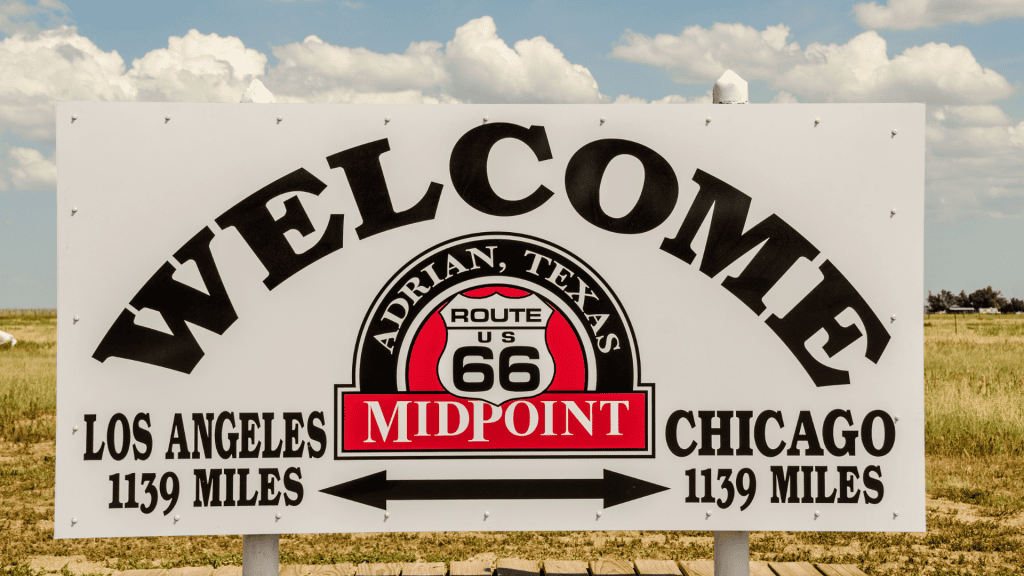
Welcome to Texas, where Route 66 attractions get big and bold. Once you cross the Lone Star state line, make a point to stop off in Adrian, the exact halfway point of Route 66.
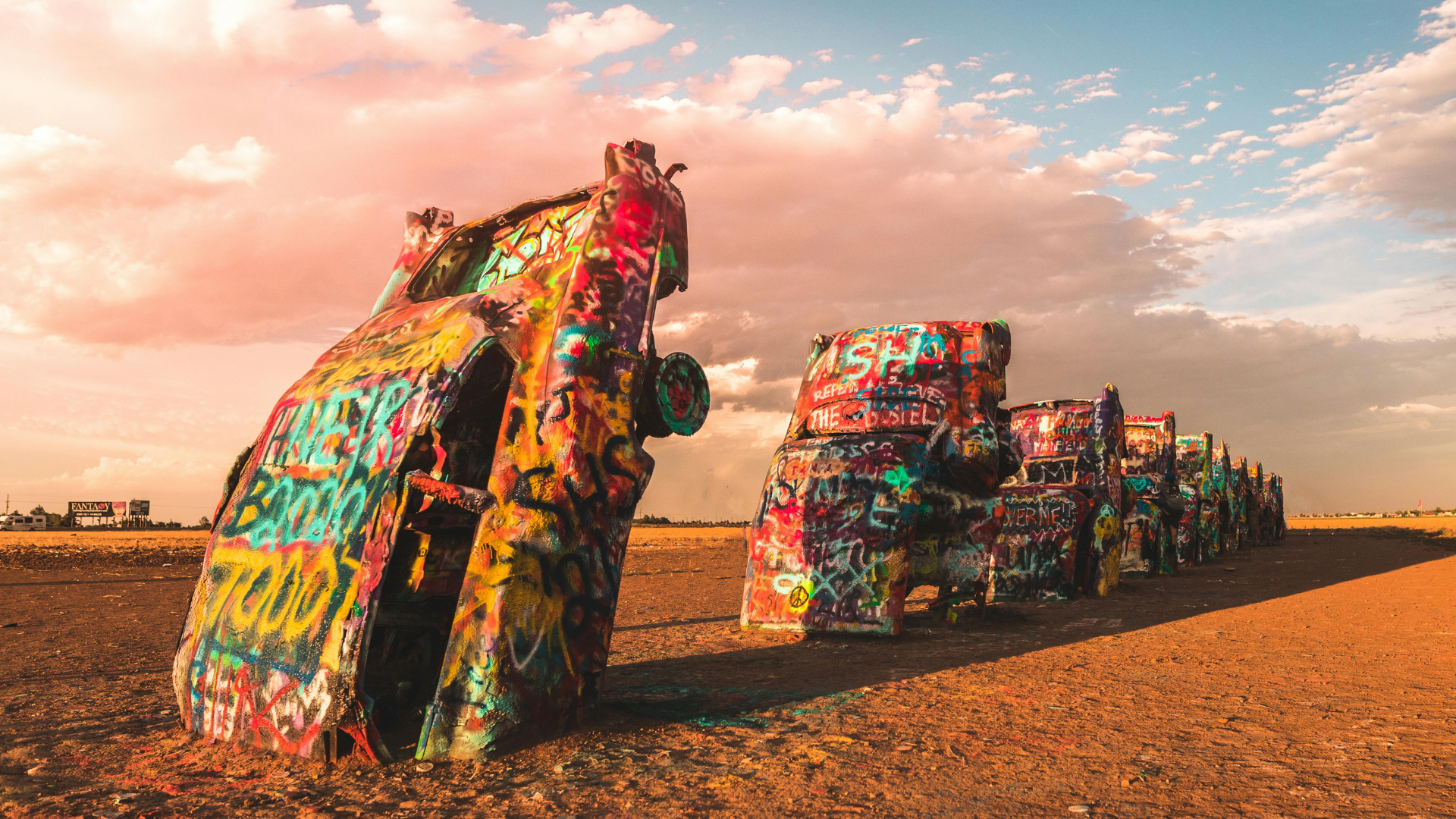
Cadillac Ranch outside Amarillo is exactly as weird and wonderful as advertised. Ten Cadillacs buried nose-first in a Panhandle field, angled to match the Great Pyramid of Giza, covered in layers of spray paint contributed by visitors since 1974. Bring your own can and add your mark to automotive history. A few miles east in Conway, Slug Bug Ranch answers with five VW Beetles buried the same way — a cheeky, comical homage.
Amarillo rewards a proper afternoon stroll through the 6th Street Historic District, thirteen blocks of Art Deco buildings, antique stores, murals, and cold beer. History and horse enthusiasts shouldn’t miss the American Quarter Horse Hall of Fame & Museum, a deep dive into Western heritage, cowboy culture, and the legendary horse that built the American West.
Cap the evening with a stop at the Big Texan Steak Ranch — even if you’re not taking on the 72-ounce / 2 kg steak challenge, the spectacle is unmissable.
Where to Stay:
Big Texan Motel (designed to resemble a main street in an old west town)
Hampton Inn Amarillo (families)
Where to Eat:
Golden Light Café (Amarillo’s oldest restaurant)
Tyler’s BBQ (serious Texas brisket)
DAY 6: AMARILLO, TX
Amarillo, Texas
The Grand Canyon of Texas & the Mammoth Hunters
Take a day off the road and go deep — literally and figuratively — into the Texas Panhandle.
Thirty-five miles north of Amarillo, Alibates Flint Quarries National Monument preserves ancient quarries used by Native Americans for 13,000 years; ranger-guided tours are the only way in, and they’re well worth booking ahead.
Go south to Palo Duro Canyon State Park, the second-largest canyon in the United States at 120 miles / 193 km long and 800 feet / 244 m deep, where staggering red rock formations blaze orange and crimson in the afternoon light. Hike, mountain bike, or explore on horseback.
If you’re here in summer (June through August), see an evening performance of the TEXAS Outdoor Musical in the canyon’s natural amphitheater. A musical romance that brings to life the stories of adversity and achievement of settlers in the Texas panhandle in the 1880s. It’s been one of the region’s most cherished Route 66 Texas attractions for 60 years.
Where to Stay:
Rustic CCC-built cabins on the canyon rim (book well ahead),
Dove’s Rest Luxury Cabins (private, remote, luxury)
Where to Eat:
Sad Monkey Mercantile (named for the rock formation above the TEXAS amphitheater)
DAY 7: AMARILLO, TX TO CLINTON, OK
Amarillo to Clinton
Oklahoma Hospitality
Back on the Mother Road, heading east. In McLean, Texas, the Devil’s Rope Museum is a whole institution dedicated to barbed wire, open March through October, it’s genuinely, surprisingly fascinating.
Then Shamrock, Texas delivers the architectural highlight of the Texas Panhandle; the Conoco Tower Station & U-Drop Inn Cafe, a 1936 Streamline Moderne masterpiece is considered one of the most beautiful buildings on all of Route 66. A National Historic Landmark, it looks like something from another world — or at least another decade. This destination is one of several Texas Route 66 attractions that were inspiration for the movie Cars.
Cross into Oklahoma at Texola, a ghost town of crumbling brick facades and a photogenic water tower that marks the state line like a portal to a different era.
In Erick, Oklahoma, stop at the Sandhills Curiosity Shop, where the legendary Harley Russell plays guitar for visitors, runs a store where nothing is for sale, and offers impromptu tours of what he calls his “redneck castle and sanitarium.” Unpredictable. Memorable. Absolutely genuine.
A recent addition to Route 66 Oklahoma attractions in Erick, is a mural honoring Roger Miller “King of the Road” who was raised here.
Spend the afternoon in Clinton at the Oklahoma Route 66 Museum, one of the finest on the entire Mother Road, with immersive galleries tracing each decade of the highway’s history through vintage cars, neon signs, and cultural artifacts.
Where to Stay:
Holiday Inn Express or Hampton Inn Clinton
Lucille’s Hotel 18 miles further in Weatherford (legendary Route 66 hospitality)
Where to Eat:
Lucille’s Roadhouse (inspired by Lucille Hamons, nicknamed the “Mother of the Mother Road”)

DAY 8: CLINTON TO OKLAHOMA CITY
Oklahoma City, Oklahoma
Big City Americana
As you head for the metropolis of Oklahoma City drive along old Route 66 that runs parallel to I-40 out of Weatherford, slow down in Hydro for a look at the original Lucille’s Historic Highway Gas Station. Lucille ran this station, diner, and hotel for 59 years along this famous highway. Of all the Route 66 Oklahoma attractions it’s a proper pilgrimage stop.
About 15-miles further the route swings northeast and crosses the South Canadian River over the Bridgeport Bridge, commonly known as the Pony Bridge for its 38 pony trusses that span 3,880 feet (1,158 m) across the river. The river presented several major challenges to bridge building: a quicksand riverbed, deep bedrock, and unpredictable floodplains. Placed on the National Register of Historic Places in 2020 this bridge was an exceptional feat of engineering. It had a cameo appearance in the 1939 film adaptation of The Grapes of Wrath.
In Oklahoma City, the Bricktown Entertainment District offers great lunch options along a restored warehouse waterway. History buffs should carve out a couple of hours for the National Cowboy & Western Heritage Museum, the Smithsonian of the American West, with an extraordinary collection of Western art and rodeo history that deserves its reputation.
And, if you feel drawn to this, spend a little time at the Oklahoma City National Memorial & Museum. This moving, beautifully designed tribute to the 1995 bombing is among the most important memorials in the country.
Where to Stay:
Skirvin Hilton Oklahoma City (1911 Art Deco)
Hampton Inn Bricktown (great for families)
Where to Eat:
Cattlemen’s Steakhouse in Stockyards City (legendary since 1910)
POPS 66 (modern, memorable soda pop stop)
DAY 9: OKLAHOMA CITY TO TULSA
Tulsa, Oklahoma
Where Route 66 Started
If you didn’t stop at POPS 66 for dinner last night, where a 66-foot illuminated neon soda bottle announces your arrival, pop in for breakfast. It’s one of the great modern Route 66 photo ops and just as impressive in daylight. Over 700 varieties of soda from across America await inside.
Just up the road, the Arcadia Round Barn, built in 1898, is one of Oklahoma’s most iconic structures with extraordinary interior acoustics.
On the final stretch of the southern Great Plains, Route 66 is packed with some of the most photogenic stops on the entire route. Leave Arcadia on the original alignment, passing through Chandler and Stroud, where the Rock Café, built in 1939 from local sandstone, is one of Route 66’s most beloved diners.
In Sapulpa, the Heart of Route 66 Auto Museum keeps things wonderfully weird with the world’s tallest (non-operational—as yet) gas pump and a chance to drive a vintage Model T Ford. (This will require driver training, additional cost, and at least a half day of your time—so plan accordingly.)
As you near Tulsa, the Route 66 Historical Village is free and open 24/7. This hands-on, open-air park is a great photo op and fun stop for all ages with a massive Frisco steam engine, a 1920s Phillips 66 station replica, a 154-foot oil derrick, and vintage train cars on the village grounds.
End where this road began, conceptually, at Cyrus Avery Centennial Plaza, dedicated to Cyrus Avery who lobbied and worked to create the highway in 1926. Bronze sculptures, interpretive panels, and the original 1917 Avery Bridge over the Arkansas River mark the spot.
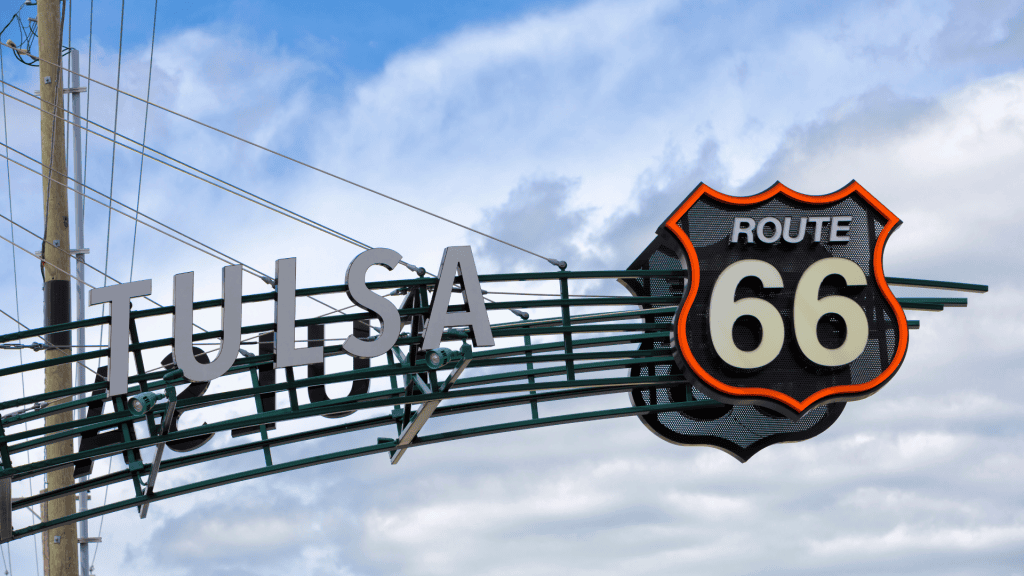
Route 66 Neon Sign Park bursts with color against a darkening sky from the evolving outdoor gallery of restored neon signs from across Tulsa’s Mother Road history.
This is where you take a breath, look back down the road you’ve just traveled, and understand why it’s called the Mother Road.
Where to Stay:
The Mayo Hotel (Art Deco landmark, welcomed JFK and Elvis)
Philtower Boutique Hotel (romantic, 1920s tower)
Where to Eat:
Tally’s Good Food Café (classic diner)
Mother Road Market (food hall, dozens of local vendors)
McNellie’s Pub (craft beer, local institution)
Other things to see/do:
Blue Whale of Catoosa, on the outskirts of northeast Tulsa, is an 80-foot smiling blue whale sitting serenely on the shore of a small pond. It’s one of Route 66’s most beloved and most photographed roadside sculptures.
Buck Atom’s Cosmic Curios, say hello to Buck Atom, the 21-foot spaceman Muffler Man, and his companion Stella Atom who arrived in 2020.
From the ancient pueblos of New Mexico to the high plains of Texas to the southern hospitality of Oklahoma, this stretch of the Mother Road delivers everything Route 66 promised when it was born 100 years ago. It’s a road that doesn’t just take you somewhere — it shows you what America is.
Want to learn more about Route 66? Check out more related content:
Everything You Need to Know About Route 66
Route 66: California-Arizona Itinerary
Route 66: Chicago through the Midwest